What Are Users Really Searching For? The Shift From Keywords to Intent
People stopped typing keywords and started asking questions. Here's what changed, why it matters for AI search, and how to write for it.
 Yunus MakasAI Visibility & GEO9 min read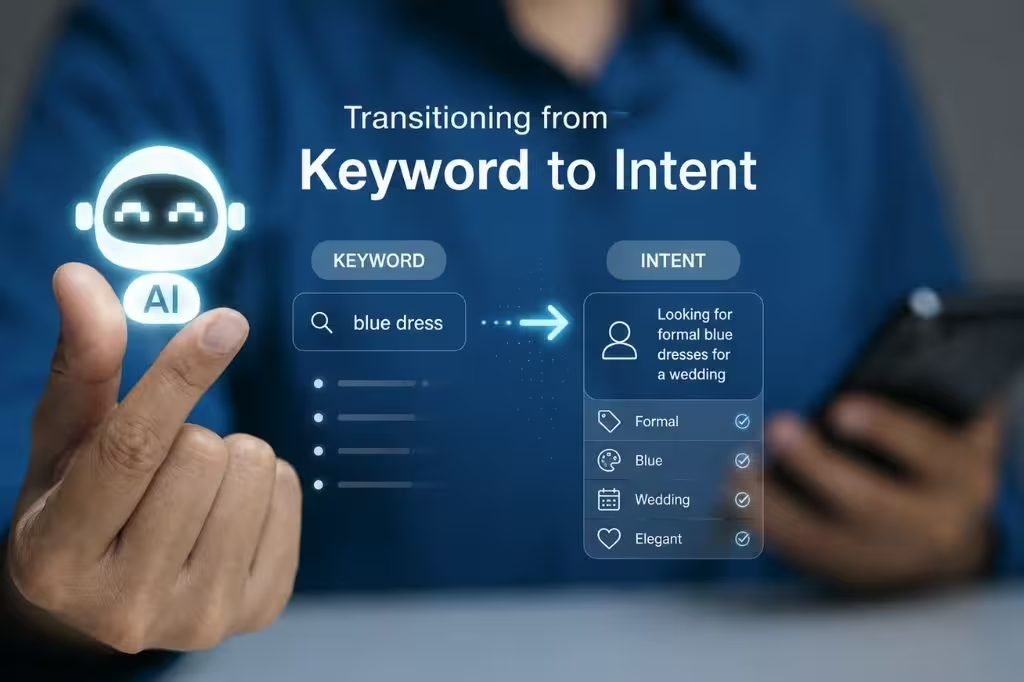
Ten years ago, someone looking for help with a home renovation typed three words into Google: “Ankara contractor firm.” Today, the same person is more likely to type this into ChatGPT:
Then
“Ankara contractor firm.”
Now
“I need to finish renovating a 3-bedroom apartment in Ankara within 20 days. I want a contractor who provides a completion certificate and has strong references. How do I choose one?”
That's not a longer version of the same search. It's a different kind of search altogether. The sentence carries a location, a scope, a timeline, a trust requirement, and a request for guidance, all at once. Understanding why that shift happened, and what it means for how you write content, is the foundation of everything else in AI search visibility.
This piece sits between two others worth reading alongside it: start with what GEO actually is for the foundation, or see why your brand doesn't show up in ChatGPT for the common failure points. Here's the piece in between: what people are actually asking now, and why it changes what you should write.
From Typing Words to Asking Questions
Search boxes used to train people to think in fragments. You didn't type a full sentence, you typed the smallest string of words likely to return a useful result. That habit shaped two decades of content strategy: find the keyword, build the page around it, rank for it.
Three things changed that pattern, and they changed it at the same time.
Natural language became the default
People no longer “type keywords,” they ask questions. Sentences arrive complete, contextual, and often conditional, the way you'd actually talk to a knowledgeable person.
Intent stacked into a single query
One sentence now carries multiple criteria at once: speed, trust, budget, certification, location, all folded into a single request instead of split across separate searches.
Queries became decision-oriented
People aren't searching to gather information anymore so much as searching to decide. They expect the answer itself to hand them what they need to act on.
Put together, this means something simple but easy to miss: users now expect a paragraph's worth of answer to a sentence's worth of question, and they want every piece they need for their decision inside that one response.
Why Keyword Tools Miss This Shift
Keyword research tools are built to measure the parts of user behavior that are easy to quantify: monthly search volume, competition score, difficulty rating. What they can't capture is the actual sentence a person would use to describe their problem, because that sentence rarely gets typed into a search bar the way it gets typed into ChatGPT, said on a sales call, or written in a WhatsApp message.
This creates a blind spot that's easy to underestimate. Consider a law firm that assumes its ideal clients search for something like “Ankara divorce lawyer.” In reality, the client's actual concern is closer to: “I'm about to go through a divorce. I don't know how the process works. I need someone who's handled similar cases and can guide me on custody and finances without me losing what I'm entitled to.” A keyword tool would break that into fragments like “divorce lawyer,” “custody case,” and “family law Ankara,” and in doing so, it would erase the actual concern and decision criteria behind the search.
The data backs this up at scale. Semrush's analysis of 200,000 AI Overviews found that 82% are triggered by keywords with under 1,000 monthly searches (Semrush, 2024). The queries AI search is actually built around aren't the high-volume phrases keyword tools are optimized to find. They're the specific, natural-language, long-tail questions that only show up when you go looking for them in the right places.
Query Intent Now Behaves Very Differently by Type
Not every kind of search benefits from this shift equally, and AI search engines don't treat all query types the same way.
Seer Interactive's 2026 data shows the gap clearly: AI Overviews appear in roughly 36% of informational queries, compared to 8% of commercial queries, and only 5% of transactional queries (Seer Interactive, 2026).
The pattern makes sense once you see it. When someone is trying to learn something, AI search shows up in force. When someone is ready to buy, AI search tends to stay in the background and let classic search results, comparison pages, and product pages do the work.
That means each query type deserves a different content approach:
Informational queries
Someone is learning. This calls for definitions, guides, explanations, and comparisons. The GEO opportunity here is citation and brand mention, not direct traffic.
Commercial queries
Someone is comparing options. This calls for comparison pages, expert opinions, and case studies. The opportunity spans both classic SEO ranking and AI citation.
Transactional queries
Someone is ready to act. This calls for service pages, product pages, and clear conversion paths. Classic SEO still does most of the heavy lifting here.
Treating every page as if it serves an informational intent, a common mistake, tends to produce content that generates neither traffic nor conversions.
The Conversion Paradox: Small Volume, Outsized Value
Here's the part that makes this shift worth taking seriously even if you're skeptical of the traffic numbers. Ahrefs' June 2025 research found that visitors arriving from AI-powered search platforms made up only 0.5% of total traffic, yet accounted for 12.1% of all signups, a conversion rate roughly 23 times higher than traditional organic traffic (Stox, 2025).
The explanation lines up with everything above. These visitors arrived through a natural-language, intent-heavy question. By the time they reach your site, they've often already been through a comparison process inside the AI conversation itself. They're not browsing, they're confirming a decision they've largely already made.
How to Find What Users Are Actually Asking
If keyword tools only show the measurable surface of user behavior, where do you find the real question underneath it? Three sources consistently work.
Conversation sources
Sales calls, phone recordings, email threads, WhatsApp or Instagram messages, and customer support notes. This is where real concerns show up in the exact words customers use.
Public real-question sources
Reddit, Quora, industry forums, YouTube comments, Facebook groups, and the sub-questions buried inside Google's “People Also Ask” boxes.
Your own analytics
Internal site search logs, chatbot conversation logs, and the page combinations people visit most often in a single session.
A brand that regularly mines these three sources ends up writing for the questions people actually ask, instead of the questions a content calendar assumes they're asking. That distinction is where most of the gap in AI search visibility actually comes from.
Writing Content That Matches How People Actually Ask
Once you have the real question, three techniques consistently help translate it into content AI systems can parse and cite.
Use question-format headings
Writing H2 and H3 headings the way a user would actually phrase the question, “What is GEO?” instead of “Overview,” makes it easier for both search engines and AI models to recognize that a section directly answers a specific question.
Build a question-and-answer rhythm into the body copy
Not every paragraph needs to be pure explanation. Short internal questions like “Why does this matter?” or “When should this be handled differently?” keep the reading flow natural while creating short, self-contained answer units a model can extract cleanly.
Design FAQ architecture, not just an FAQ section
The distinction matters. A handful of questions bolted onto the bottom of a page is not the same as designing the entire page as a connected system of questions and answers, from the headings through the examples to the conclusion. Marking this structure up with FAQ schema where appropriate reinforces it for machine parsing as well.
Key Takeaways
- Search behavior shifted from short keyword fragments to complete, natural-language, context-rich questions, and that shift is what GEO content strategy is built around.
- Keyword tools measure only the visible surface of demand: 82% of AI Overviews are triggered by low-volume, long-tail queries that standard keyword research tends to underweight (Semrush, 2024).
- AI visibility varies sharply by query type: roughly 36% for informational queries versus 8% for commercial and 5% for transactional queries (Seer Interactive, 2026).
- AI-referred visitors are rare but highly qualified, converting at roughly 23 times the rate of traditional organic traffic despite being a small share of total visits (Stox, 2025).
- The richest source of real user language isn't a keyword tool. It's sales conversations, public forums, and your own site search and chatbot logs.
- Question-format headings, a natural Q&A rhythm in body copy, and true FAQ architecture (not just an FAQ section) are the most direct ways to write for this shift.
Frequently Asked Questions
Because user expectations changed alongside model capability. People increasingly search to decide rather than to browse, and AI systems can now handle full natural-language questions instead of requiring users to compress their need into a few keywords.
Yes, but as a starting point rather than the finished brief. Keyword research still surfaces topics worth covering; the real question is finding the natural-language version of that topic that reflects how someone would actually ask it.
Review a month of sales call notes or support tickets and log the exact questions customers ask in their own words. This alone usually surfaces content gaps that keyword research never would have found.
Not equally. Informational queries see the highest AI Overview visibility, while commercial and especially transactional queries still lean heavily on classic search and direct conversion paths.
Not all at once. Start with your highest-traffic informational pages, rewrite headings into question format, and check whether the page actually answers the real underlying question rather than just the keyword it was originally built around.
References
- 01Semrush. (2024). We Studied 200,000 AI Overviews: Here's What We Learned. Semrush Blog.
- 02Seer Interactive. (2026). AIO Query CTR Recovery: Early 2026 Update. Seer Interactive Research.
- 03Stox, P. (2025, June 16). AI Search Visitors Convert 23x Higher than Organic Traffic. Ahrefs Web Analytics Research.
- 04BrightEdge. (2026, January). AI Overviews Sector Analysis: Healthcare vs Finance. BrightEdge Research.
Written by
Yunus Makas
AI Visibility and GEO consultant based in Agder, Norway, helping businesses become discoverable, citable, and technically sound across AI search.