What Is GEO? The New Rules of Visibility in AI Search
Search didn't just change, it inverted. Here's how Generative Engine Optimization (GEO) helps brands become the source AI recommends.
 Yunus MakasAI Visibility & GEO8 min read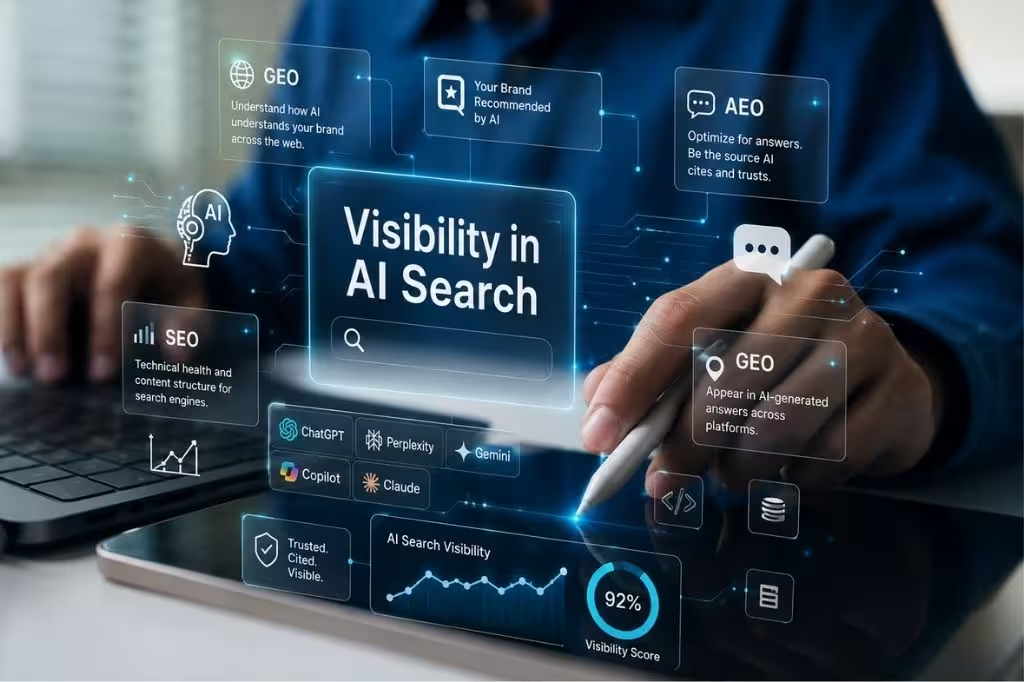
A few years ago, being findable meant one thing: rank on page one of Google. Today, a growing share of your customers never see page one at all. They ask ChatGPT, Perplexity, or Google's AI Overviews a question, then act on whatever answer comes back, often without clicking a single link.
That shift has a name: Generative Engine Optimization (GEO), the practice of making your brand and content understandable, trustworthy, and citable enough that AI systems choose to reference you inside the answers they generate.
This isn't a rebrand of SEO. It's a new layer sitting on top of it. Here's what that actually means, why it matters now, and how it's different from the SEO and AEO work you may already be doing.
What Is GEO, Exactly?
GEO stands for Generative Engine Optimization: the set of practices that help your brand and content get correctly understood, selected as a trustworthy source, and referenced by generative AI-powered search systems, including ChatGPT, Perplexity, Google AI Overviews, Claude, Gemini, and Copilot.
The shift at the core of GEO is simple to visualize:
- Classic search: user, then search engine, then ten blue links, then your website.
- Generative search: user, then AI system, then one synthesized answer, then (sometimes) a source link.
The goal isn't just to rank anymore. The goal is to get inside the answer. Having your brand named, your sentence quoted, or your product mentioned as an example inside an AI-generated response is valuable in its own right, even before anyone clicks through. And because users increasingly trust AI-generated answers, traffic that does arrive from an AI referral tends to convert faster, because the visitor has already been “pre-sold.”
How Is GEO Different from SEO and AEO?
These three acronyms get used interchangeably, which creates real confusion. Here's the distinction:
SEO: Search Engine Optimization
Getting a page to rank for a target keyword on Google or Bing. Success is measured in rankings, clicks, and organic traffic.
AEO: Answer Engine Optimization
Producing content structured to directly answer a question, the discipline behind featured snippets, “People Also Ask” boxes, and voice assistant responses. Success is measured by whether you win the answer box.
GEO: Generative Engine Optimization
Getting your brand and content selected as a source inside AI-synthesized answers: named, quoted, and preferred. Success is measured by AI visibility, brand mentions, and citation frequency.
A simple way to remember it:
- SEO makes you visible.
- AEO makes you the answer.
- GEO makes you the source.
Critically, GEO does not replace SEO. It builds on it. An April 2026 analysis by Ahrefs of 1.4 million ChatGPT prompts found that roughly 88% of the URLs ChatGPT cited were pulled directly from the general search index (Ahrefs, 2026). In other words, if your page isn't well-indexed and discoverable through classic search, it's very unlikely to be cited in an AI answer either. SEO and GEO are separate disciplines standing on the same foundation.
Why Is This Happening Now?
The shift didn't start loud. It started quiet, and then accelerated fast.
According to Bain & Company's February 2025 research, 80% of consumers now trust AI-generated results for at least 40% of their searches, and roughly 60% of Google searches now end without the user clicking through to any website (Bain & Company, 2025). Bain describes this not as a routine algorithm update, but as a structural shift in how people search.
The behavioral change comes down to what “getting an answer” now looks like:
- Before: ask a question, open several links, compare them yourself, form your own conclusion.
- Now: ask a question, receive one synthesized answer, often stop there.
Three forces are driving this at once:
- User expectations. People want speed, ask in natural language, and are searching to decide, not to browse.
- Model maturity. Large language models (LLMs) can now select sources, synthesize information, and build context, not just generate text.
- Platform incentives. Google, Microsoft, OpenAI, and Perplexity all have reasons to keep the answer inside their own ecosystem rather than sending users elsewhere.
Why GEO Has Become Critical for Brands
This isn't theoretical. It shows up directly in revenue.
Organic traffic is already eroding
Bain reports that AI-generated summaries are reducing organic web traffic by roughly 15% to 25% (Bain & Company, 2025). Separately, a December 2025 Ahrefs study covering 300,000 keywords found that Google's AI Overviews feature cuts the organic click-through rate for position-one content by as much as 58% (Law, 2025). Ranking first no longer guarantees a click.
A new visibility economy is forming
McKinsey projects that by 2028, roughly $750 billion in U.S. revenue will be routed through AI-powered search (Silliman et al., 2025). Brands that build GEO capability early are positioned to capture disproportionate share of that shift; those that wait risk losing 20% to 50% of their traditional search traffic over the same period, according to the same report.
AI-referred visitors convert differently
Someone arriving from an AI-generated recommendation has usually already compared options and formed a preference before they land on your site. They're arriving to confirm a decision, not to start researching one, which tends to make them a higher-intent visitor than a typical organic click.
What Actually Gets Cited by AI Search Systems?
This isn't a matter of guesswork; there's research behind it. A 2024 study by Princeton researchers, presented at the ACM SIGKDD Conference, tested different content optimization strategies against generative-engine visibility and found that adding statistics, authoritative citations, and fluent, clear language could lift visibility in AI-generated answers by up to 40% (Aggarwal et al., 2024).
Separately, SE Ranking's November 2025 analysis of ChatGPT's citation behavior found that domain authority and social proof are decisive factors:
- Sites with more than 32,000 referring domains were cited roughly 3.5x more often than sites with under 200.
- Domains with strong brand mentions on Quora and Reddit were about 4x more likely to be cited than domains with minimal presence there.
- Sites with active profiles on Trustpilot, G2, Capterra, Sitejabber, or Yelp were roughly 3x more likely to be selected as a source by ChatGPT (SE Ranking, 2025).
Put together, the profile of a citation-worthy page is consistent: it includes real data and statistics, cites its own sources, is written clearly enough to quote directly, lives on a domain with established authority, and sits inside a visible ecosystem of third-party mentions, not as an isolated page, but as part of a broader topical presence.
If your business is already publishing content but still isn't being mentioned, the next step is diagnosing why your brand doesn't appear in ChatGPT.
Where GEO Is Headed
Three trends are worth planning around now, not later:
- The line between SEO and GEO will keep blurring. What we currently treat as two disciplines may converge into a single “search visibility” practice within a few years.
- Authority and trust will outweigh technical tricks. AI models don't just match keywords, they weigh brand history, third-party mentions, and sector credibility when choosing what to cite. That pushes link building toward something broader: mention building.
- Websites will stop functioning as brochures and start functioning as information systems. Sites structured for AI parsing, with clear hierarchy, unambiguous answers, and strong internal linking, will outperform sites optimized purely for aesthetics.
Key Takeaways
- GEO is not a replacement for SEO. It's a new layer built on top of it, focused on getting cited as a source inside AI-generated answers.
- User behavior has fundamentally shifted: around 60% of Google searches now end without a click to any website (Bain & Company, 2025).
- Ranking #1 no longer guarantees traffic: AI Overviews can cut click-through rates for top-ranked content by up to 58% (Ahrefs, 2025).
- A new visibility economy is emerging: McKinsey projects $750 billion in AI-search-driven revenue by 2028 (Silliman et al., 2025).
- Citation-worthy content shares a clear profile: data-backed, clearly written, authoritative, and embedded in a visible third-party ecosystem.
Frequently Asked Questions
GEO stands for Generative Engine Optimization, the practice of optimizing brand and content visibility inside AI-generated search answers from tools like ChatGPT, Perplexity, and Google AI Overviews.
No. GEO builds on top of SEO rather than replacing it. Research shows roughly 88% of URLs cited by ChatGPT come directly from the standard search index, meaning strong SEO fundamentals remain a prerequisite for GEO visibility (Ahrefs, 2026).
AEO (Answer Engine Optimization) focuses on winning direct-answer formats like featured snippets and voice results. GEO focuses on being cited as a trusted source inside AI-synthesized, multi-source answers. They overlap but target different outcomes.
Track brand mentions across AI platforms, monitor referral traffic tagged from AI sources in analytics, and periodically query the same questions your customers ask in ChatGPT, Perplexity, and Gemini to see whether, and how, your brand appears.
No, but you do need topical depth and third-party visibility. Building a cluster of clear, well-linked content around your core expertise, supported by mentions on review platforms and community sites, matters more than sheer site size.
References
- 01Bain & Company. (2025, February 19). Consumer Reliance on AI Search Results Signals New Era of Marketing. Bain & Company Press Release.
- 02Law, R. (2025, December). AI Overviews Reduce Organic CTR for Position One Content by 58%. Ahrefs Blog.
- 03Silliman, E., Boudet, J., Robinson, K., Oppong, D. & Shah, N. (2025, October). New Front Door to the Internet: Winning in the Age of AI Search. McKinsey & Company.
- 04Ahrefs. (2026, April). ChatGPT Citation Patterns: URL Source Analysis. Ahrefs Research.
- 05Aggarwal, P., Murahari, V., Rajpurohit, T., Kalyan, A., Narasimhan, K. & Deshpande, A. (2024). GEO: Generative Engine Optimization. KDD 2024, Proceedings of the 30th ACM SIGKDD Conference on Knowledge Discovery and Data Mining (pp. 5-16). Association for Computing Machinery.
- 06SE Ranking. (2025, November). Domain Authority and Social Proof in AI Citation Patterns: What Drives ChatGPT Source Selection. SE Ranking Research.
Written by
Yunus Makas
AI Visibility and GEO consultant based in Agder, Norway, helping businesses become discoverable, citable, and technically sound across AI search.