Why Doesn't Your Brand Show Up in ChatGPT? (And How to Fix It)
Good content isn't enough. Here's why AI search engines skip most brands, and the exact fixes that get you cited instead.
 Yunus MakasAI Visibility & GEO9 min read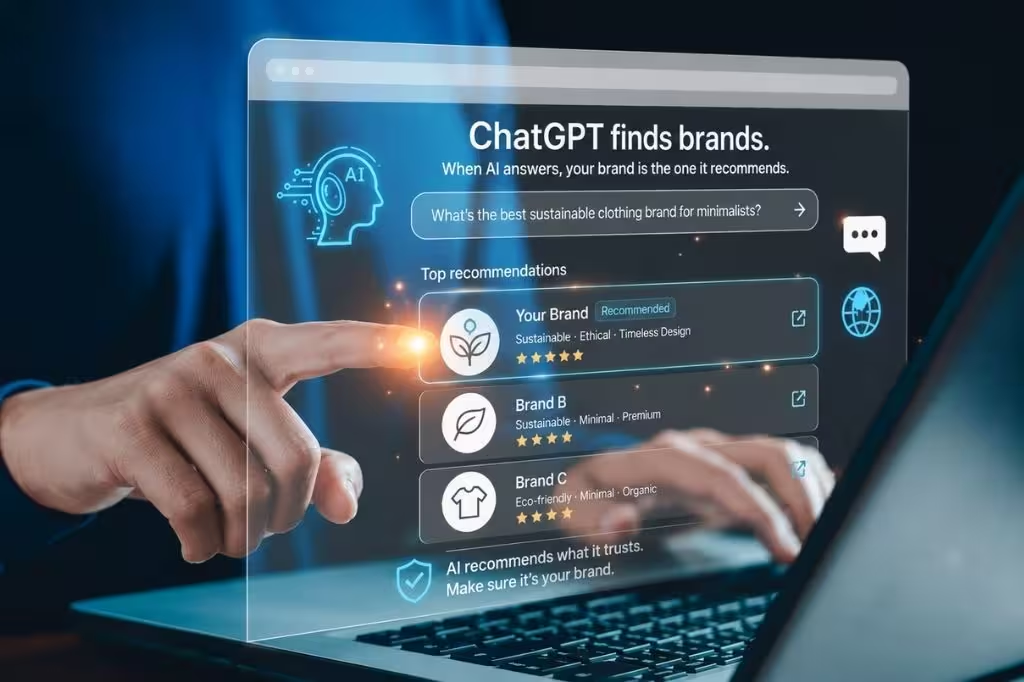
You ask ChatGPT a question you know your business answers every day. The response comes back clean, confident, and complete. Your brand isn't in it. Not even a mention.
It's tempting to write this off as luck, or assume the algorithm just hasn't “found” you yet. It hasn't, but not by accident. AI search systems make a deliberate choice about which sources to trust and cite, and that choice follows patterns you can identify and fix.
If you're new to the topic, it helps to start with what GEO actually is, then come back here for the fixes. Below are the seven most common reasons brands stay invisible in ChatGPT, Perplexity, and Google AI Overviews, along with what actually works to change it.
Reason 1: You're Still Optimizing for Keywords, Not Real Questions
For a decade, “rank #1 for this keyword” was the whole game. That instinct doesn't disappear easily, but it actively works against you in AI search.
A Semrush analysis of 200,000 AI Overviews found that 82% of them are triggered by keywords with under 1,000 monthly searches (Semrush, 2024). AI search's main hunting ground isn't high-volume keywords. It's the long, specific, natural-language questions people actually type or speak: “Which contractor can finish a 3-bedroom renovation in Ankara within 20 days and has real references?” not “Ankara contractor.”
A page built around a keyword answers the keyword. It doesn't answer the question behind it. That mismatch is the single most common reason content never gets pulled into an AI answer.
The fix
Keep doing keyword research, but treat it as a starting point, not the brief. Find the real question behind each target keyword by mining sales calls, forums, and “People Also Ask” boxes. Write the content brief around the prompt a real person would type, not the keyword a spreadsheet suggests.
Reason 2: Your Content Is Too Surface-Level to Quote
The second most common failure point: content published to fill a calendar, not to fully answer a question.
This shows up two ways. Some brands chase volume, publishing 15 to 20 short posts a month with no data, no examples, and no real depth. Others stay shallow on purpose, writing something vague like “it depends on your business size” instead of committing to a real answer.
Either way, the result in GEO is blunt: the content simply doesn't get cited. The model finds a more thorough source on the same topic and skips yours entirely. You've spent the effort. You haven't earned the visibility.
The fix
Publish less, but go deeper. Four thoroughly researched articles a month will outperform twenty shallow ones. Every page should fully resolve one question, include at least one real statistic or example, and ideally reflect an actual expert's input from inside your team.
Reason 3: Technical Issues Are Hiding You From AI Crawlers Entirely
Sometimes the content is genuinely good, and it still never shows up, because the model can't reach it in the first place. The most common technical blockers include:
- An accidental noindex tag left over from testing.
- A broken canonical pointing to the wrong page.
- Critical content that only loads via JavaScript, which many crawlers never render.
- Long redirect chains that burn through crawl budget.
- Slow pages that fail Core Web Vitals.
- Missing structured data that leaves the page uncategorized.
- Broken or orphaned pages that weaken overall site health.
No matter how well the content is written, none of it matters if the underlying page never gets properly crawled, indexed, or parsed.
The fix
Get your content and technical teams reviewing pages together, not in separate silos. Run every new page through a technical checklist before publishing, and schedule a full technical audit at least once a month.
Reason 4: You Have No Authority or Trust Ecosystem Around Your Site
This is the failure mode brands notice last, because it's invisible until you go looking for it. The content is solid. The technical setup is clean. But there's no surrounding signal that tells an AI model your brand can be trusted. Common gaps:
- A thin “About Us” page with no real team information.
- Missing or incomplete author bios.
- No presence on Trustpilot, G2, or Capterra.
- Outdated or sparse Google Business reviews.
- No sameAs schema connecting your entities.
- Little to no active LinkedIn presence.
- Zero mentions in industry media, Reddit, or Quora.
According to SE Ranking's November 2025 research, domains with more than 32,000 referring domains were cited by ChatGPT roughly 3.5 times more often than domains with under 200, domains with strong Reddit and Quora mentions were cited about 4 times more often, and domains active on review platforms like Trustpilot and G2 were 3 times more likely to be selected as a source (SE Ranking, 2025). A separate 2026 analysis of over 100,000 prompt responses across more than 100 brands found that AI visibility varies sharply by authority tier, with established brands appearing far more often than smaller or niche ones, though niche brands with the right signal ecosystem still capture meaningful visibility (Generative Engine Optimization at Scale, 2026).
The fix
Rebuild your About page around story, team, numbers, and proof, not just a mission statement. Add an author bio and profile link to every piece of content. Open and actively manage profiles on the review platforms relevant to your industry. Mark up Organization and Person schema completely.
Reason 5: You're Using One Playbook for Every AI Platform
Getting cited on one platform doesn't mean you'll get cited on another, and treating them identically is a quiet way to waste effort.
A 2025 report from The Digital Bloom found that citation overlap between ChatGPT, Perplexity, and Google AI Overviews is only about 11% (The Digital Bloom, 2025). Each platform weighs different signals:
- ChatGPT leans on both its training data and live search index strength.
- Perplexity favors source diversity and recency.
- Google AI Overviews stays tightly bound to classic SERP performance.
- Gemini draws on Google's entity graph.
- Copilot relies on the Bing index and Microsoft's ecosystem.
The fix
Build a GEO strategy with three layers instead of one blanket approach: a common baseline that works everywhere, platform-specific emphasis for where your audience actually searches, and separate tracking for each platform so you can adjust based on what's actually working.
Reason 6: You're Relying Only on Your Blog
Publishing consistently and still seeing no movement is one of the most frustrating patterns in GEO, and it usually traces back to one assumption: that content means blog content.
McKinsey's October 2025 analysis found that only 5% to 10% of the content used in AI-generated summaries about a brand comes from that brand's own website. The rest comes from sources the brand doesn't directly control (Silliman et al., 2025). In other words, roughly 90% of what AI says about you is being written somewhere you don't own.
A blog alone only feeds a small slice of that picture.
The fix
Expand beyond blog posts into service pages, category pages, FAQs, glossary content, and case studies. Add other formats: video, podcast appearances, LinkedIn posts, infographics. Show up authentically on Reddit and Quora, contribute guest articles to industry media, and actively build reviews on third-party platforms. Blog content is one leg of the system, not the whole system.
Reason 7: You Never Set Up a Way to Measure Any of This
The last common failure isn't a content or technical problem. It's an operational one: brands do the work, then never check whether it's working.
Without a measurement system in place, you can't tell which content is actually getting cited, which technical fixes moved the needle, where to direct the next round of investment, or how to report progress to leadership. GEO efforts without measurement tend to quietly stall after six to nine months, simply because no one can see what to adjust.
The fix
Set up a minimum measurement stack: standard SEO tracking through Search Console and GA4, a manual monthly check of 20 to 30 key prompts across AI platforms, brand-mention monitoring through tools like Google Alerts or a brand monitoring platform, referral tracking in GA4 for AI-driven traffic, and a monthly reporting rhythm that turns data into decisions.
In one recent project, this process helped an Istanbul-based textile manufacturer acquire its first confirmed customer through ChatGPT within 45 days.
Key Takeaways
- Keyword-only thinking is the most common cause of AI invisibility: 82% of AI Overviews are triggered by low-volume, long-tail, natural-language queries (Semrush, 2024).
- Shallow content simply doesn't get cited. Depth and specificity beat publishing volume.
- Strong content on a broken technical foundation still stays invisible to AI crawlers.
- Authority signals compound: strong backlink profiles, brand mentions, and review presence can multiply citation likelihood by 3x to 4x (SE Ranking, 2025).
- Each AI platform behaves differently. Citation overlap between ChatGPT, Perplexity, and Google AI Overviews is only about 11% (The Digital Bloom, 2025).
- Roughly 90% of what AI says about your brand comes from sources outside your own website (Silliman et al., 2025), so blog content alone is not enough.
- Without a measurement system, GEO progress is invisible and tends to stall within six to nine months.
Frequently Asked Questions
Usually a combination of factors: content built around keywords instead of real questions, insufficient depth to be quotable, technical barriers blocking AI crawlers, weak authority signals around the site, or reliance on a single content format like blog posts alone.
Most brands see initial technical and content fixes reflected within 60 to 90 days, with authority-building signals (reviews, third-party mentions, backlinks) typically taking 3 to 6 months to show measurable impact.
No. Research shows AI models weigh domain authority, brand mentions on platforms like Reddit and Quora, and third-party review presence alongside content quality. A well-written page on a domain with no surrounding trust signals is still frequently passed over.
No. Citation overlap between major AI platforms is only around 11%, meaning visibility has to be built and tracked separately for each one rather than assumed to transfer automatically.
For most brands, closing the authority and trust gap (author bios, About page depth, third-party review presence, consistent brand information across platforms) produces the most durable improvement, because it affects how every other piece of content gets evaluated.
References
- 01Semrush. (2024). We Studied 200,000 AI Overviews: Here's What We Learned. Semrush Blog.
- 02SE Ranking. (2025, November). Domain Authority and Social Proof in AI Citation Patterns: What Drives ChatGPT Source Selection. SE Ranking Research.
- 03Silliman, E., Boudet, J., Robinson, K., Oppong, D. & Shah, N. (2025, October). New Front Door to the Internet: Winning in the Age of AI Search. McKinsey & Company.
- 04The Digital Bloom / ZipTie.dev. (2025). Cross-Platform AI Citation Overlap Report.
- 05Generative Engine Optimization at Scale. (2026, June). arXiv preprint.
- 06Aggarwal, P., Murahari, V., Rajpurohit, T., Kalyan, A., Narasimhan, K. & Deshpande, A. (2024). GEO: Generative Engine Optimization. KDD 2024, Proceedings of the 30th ACM SIGKDD Conference on Knowledge Discovery and Data Mining.
Written by
Yunus Makas
AI Visibility and GEO consultant based in Agder, Norway, helping businesses become discoverable, citable, and technically sound across AI search.